Space

- Space
Here’s why the moon must get its own time zone
But should moon time be like Earth time — or quite different? At issue: The moon’s lesser gravity will make seconds there tick faster than on Earth.
- Earth
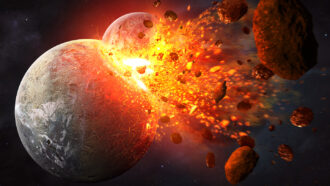
One collision could have formed the moon and started plate tectonics
A hypothetical planet slamming into Earth 4.5 billion years ago might have set subduction into motion.
- Planets
Research on exoplanets took top award at 2023 Regeneron ISEF
Six young researchers took home the top awards, each valued at a minimum of $50,000. Hundreds more shared nearly $9 million in prizes at international event.
- Earth
Scientists Say: Altitude
Altitude is used to describe heights in geography, astronomy and math.
- Planets
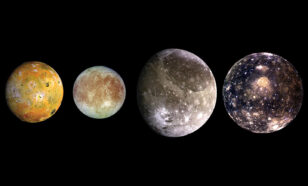
Let’s learn about Jupiter’s moons
Jupiter has nearly 100 known moons — some of which look like prime spots to search for alien life.
- Space
Scientists Say: Accretion Disk
Cosmic swirls of gas, dust and plasma, accretion disks reveal the shadowy silhouettes of black holes and more.
- Planets
Planets like Star Wars’ Tatooine could be fit for life
Like Luke Skywalker’s home, planets orbiting two stars may be plentiful. A new computer model suggests that many of those worlds could sustain life.
- Space
The next astronauts to walk the moon will be more diverse than the last
Space agencies are preparing to send the next generation of astronauts to the moon and beyond. Here’s how future crews will differ from the last.
- Earth
Scientists Say: Equinox and Solstice
Equinoxes and solstices mark the maximums, minimums and mediums of hours spent in daylight.
- Space
Spacecraft traveling through a wormhole could send messages home
A probe going through a wormhole should be able to send messages home before such a tunnel forever closes, a new computer model finds.
- Planets
Saturn’s moon Enceladus wears a thick blanket of snow
Pits on the frosty moon reveal the snow’s surprising depth, up to 700 meters (2,300 feet) in some places.
- Planets
The dwarf planet Quaoar hosts an impossible ring
Quaoar’s ring lies outside the Roche limit. That’s an imaginary line beyond which rings aren’t thought to be stable.