
All Stories by Lisa Grossman
- Space
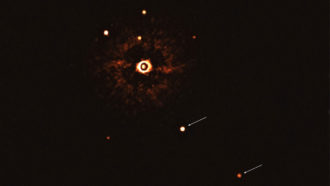
A weird cousin of our solar system is caught on camera
New photo reveals a cousin to our solar system. It’s star has a mass similar to the sun’s and is orbited by two gas giant planets.
- Planets
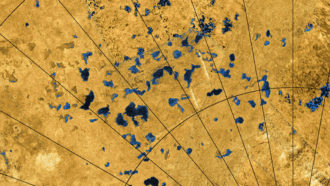
Saturn’s moon Titan may host lots of dried lakes
Suspicious spots around the moon’s middle could be the beds of ancient lakes. If so, this might solve a 20-year-old mystery.
- Space
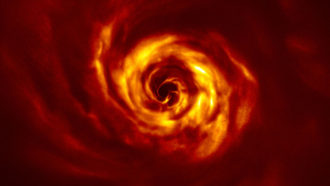
Developing planet emerges in a swirl of gas
Images of a young star 520 light-years away show a spiral of gas and dust swirling around it. A twist inside the spiral appears to be a planet forming.
- Space
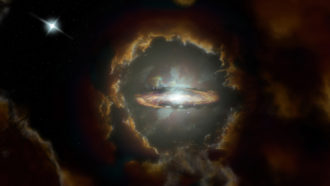
Oldest disk galaxy puts a new spin on galaxy growth
A spinning disk galaxy has been found in the early universe. Its existence is a surprise.
- Space
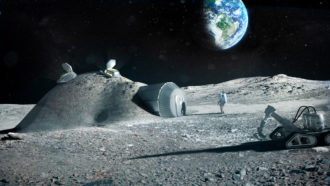
Astronauts may be able to make cement with their own pee
Lunar dust and a compound found in urine might one day be used to build future dwellings on the moon, a new study finds.
- Space
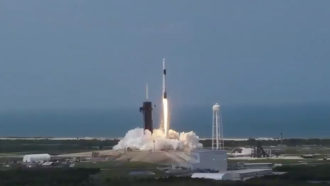
A first: Commercial rocket takes humans into space
Two NASA astronauts aboard the privately built Crew Dragon capsule are the first to be sent into orbit from U.S. soil since 2011.
- Planets
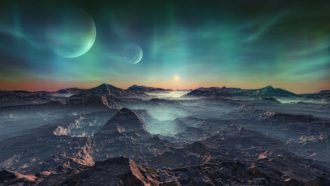
Planets with hydrogen skies could harbor life
Microbes can live in a hydrogen atmosphere. This points to new space worlds that host alien life.
-
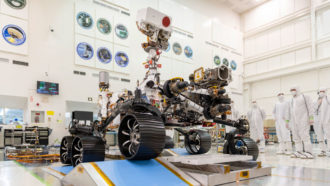
A seventh grader named NASA’s newest Mars rover
NASA’s next Mars rover will be called Perseverance.
- Space
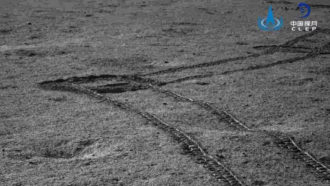
Rover finds ‘layer cake’ below ground on moon’s farside
China’s rover finds the moon’s farside is more rugged and cratered than the nearside. Now scientists want to know why.
- Planets
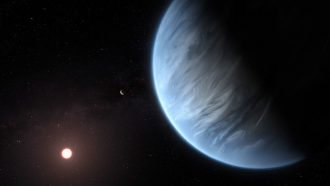
Spotted: An exoplanet where it might rain
A planet outside the solar system appears to have clouds with liquid water.
- Planets
Physics Nobel rewards discoveries on cosmic evolution and exoplanets
This trio of scientists helped figure out the makeup of our universe. Two of them also identified the first known exoplanet orbiting a sunlike star.
- Planets
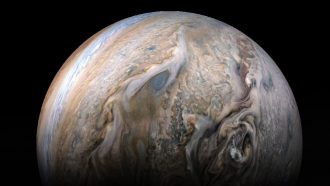
Students help name 5 of Jupiter’s newly discovered moons
Astronomers announced discovering 12 new moons of Jupiter in July 2018. Five of them now just been named for goddesses and spirits of Greek and Roman mythology.