Physics

- Chemistry
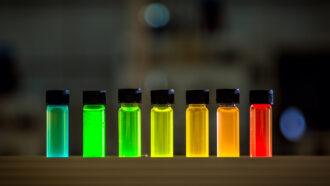
Creation of quantum dots wins 2023 chemistry Nobel
The award honors three scientists who discovered and built quantum dots, which are now used in everything from TVs to medical tools.
- Physics
‘Feathering’ helps explain Gentoos’ record-breaking swim speed
Videos and computer analyses reveal the secrets of the penguins’ superspeed. The results could inspire future underwater vehicles.
- Physics
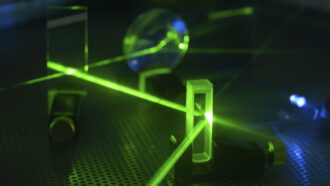
Efforts to create ultrafast light pulses win 2023 physics Nobel
Pierre Agostini, Ferenc Krausz and Anne L’Huillier won the prize for creating light bursts that last billionths of a billionth of a second.
- Chemistry
Scientists Say: Rare earth element
Rare earth elements aren’t all that rare — but skyrocketing demand for these metals makes them precious.
- Physics
Scientists Say: X-ray
X-rays are a type of light that doctors use to image the inside of the body. Astronomers use X-rays to explore the cosmos.
- Animals
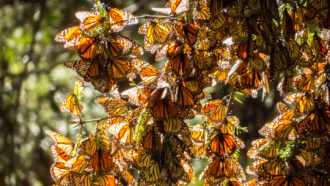
Analyze This: White wing spots may help monarch butterflies fly far
Monarchs with more white on their wings are more successful migrants, new research shows
- Materials Science
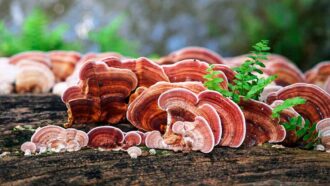
Made from fungi, this vegan leather can self-heal holes or rips
If made under gentle conditions, leather formed from the “roots” of mushrooms can retain the ability to regrow and repair minor damage.
- Tech
Gravity ‘batteries’ might help a weighty renewable-energy problem
To store the energy generated by wind and solar power, researchers are looking at mammoth systems that raise and lower weights.
- Space
Experiment: A puzzling parallax helps stargazers
In this project, we explore how perspective, or parallax, can be used to measure the distances to objects such as stars.
- Physics
Scientists Say: Radio Waves
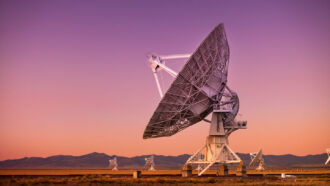
Lightning, stars, supermassive black holes and more give off radio waves.
- Tech
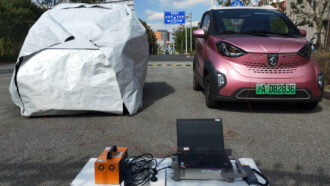
New thermal ‘cloak’ keeps spaces from getting too hot or too cold
A prototype fabric could help keep cars, buildings and other spaces cooler during heat waves while also reducing greenhouse-gas emissions.
- Chemistry
Scientists Say: Valence electrons
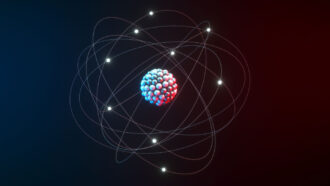
These far-out electrons do the hard work when it comes to chemical reactions.